


(Skip to the TLDR at the bottom if you’re just here for the summary.)
What Happens When the Business Works But You Don’t
I had promised my wife I would stop working at a set time that evening. And I did. I closed my laptop, walked away from my desk, and kept my word.
But earlier that day I had seen a new tool. And I could not stop thinking about it.
So there I was at dinner. My kids were telling me about their day. Funny moments. Silly things. The kind of stories you want to be fully in for. And I genuinely wanted to be there. I wanted to laugh with them. I wanted to be the dad who was actually listening.
But my mind was somewhere else entirely. Still at my desk. Still thinking about how to implement that tool.
That was the moment I knew something had to change. Not in some vague, general way. Something real had to change.

Why Online Businesses Get So Complicated in the First Place
Back in 2021, I was doing everything at once with no system at all.
Every single day I was writing LinkedIn posts from scratch with no idea what I would post tomorrow. I was manually creating blog posts without any process behind them. I was recording podcast episodes that ended up being about 5 minutes long because I had no structure going in.
And I kept adding offers. I kept adding tools. ClickFunnels. GoHighLevel. Kajabi. And those were just the funnel platforms.
My thinking made sense at the time: more offers means more people I can serve. More tools means more things I can do. That is shiny object syndrome in a nutshell, and it runs on the same fuel as optimism. It just does not run on strategy.
I landed a $5,000 per month client and a few smaller clients around $50 per month. But I lost the big one. Not because I was not capable. Because I did not have a streamlined revenue system. No single entry offer. No minimal focused tool stack. Just complexity layered on top of more complexity.
Here is what that looked like in practice:
- Too many offers pulling focus in different directions with no clear priority
- Tools that did not talk to each other across ClickFunnels, GoHighLevel, and Kajabi, just to name the funnel platforms
- Content across three channels with no structure behind any of it, a blog, a podcast, and daily LinkedIn posts
- No clear daily priority, just an endless rotating list that never got shorter
- Constant context switching that made any kind of deep focused work basically impossible
If you nodded at more than two of those, keep reading.
The Real Turning Point
At the 90 day mark of staying consistent, something broke.
I was sending 20 LinkedIn connection requests a day, posting daily, handling client delivery, onboarding new clients, and managing everything else. The only way to keep the consistency going was to stay up late. Every single night.
I remember thinking: at what cost am I growing this business? What am I missing while I am trying to build something?
But honestly, the real turning point was not a burnout moment at all.
My son had three open heart surgeries before he turned three years old.
Three.
I sat with that for a long time. And what it taught me is simple and devastating at the same time: I do not know how long I have with the people I love most. That rearranges your priorities faster than anything else in the world.
I made a decision after that. I was going to build something that worked for my life. Not the other way around.
I have over five years of marketing experience. I have spent more than five figures in personal one on one training with some of the best marketers in the world in Facebook ads, web design, and sales. I have had a physical office. I know the complexity side of this business from the inside.
And what I know now is this: simplicity scales. Complexity fails.
What Simplifying an Online Business Actually Means
Let me be clear upfront: simplifying does NOT mean doing less or making less money.
It means removing the things that are eating your time and attention without actually moving your business forward.
A simplified online business has five core elements:
- One clear core offer that solves one specific problem for one specific person
- One primary traffic source you build consistently instead of spreading thin across five platforms
- One simple conversion system, not a six funnel labyrinth with seventeen moving parts
- A minimal tool stack where every tool has one job and earns its place
- A protected weekly schedule that actually preserves time for your family
That is it. When you strip back to these five things, the chaos starts to quiet. You stop reacting and start deciding. You know what matters today. You know what to ignore.
The 5 Things Worth Cutting First
When most people think about simplifying, the instinct is to add something. A better system. A smarter strategy. Another hire.
The real leverage is almost always in what you remove.
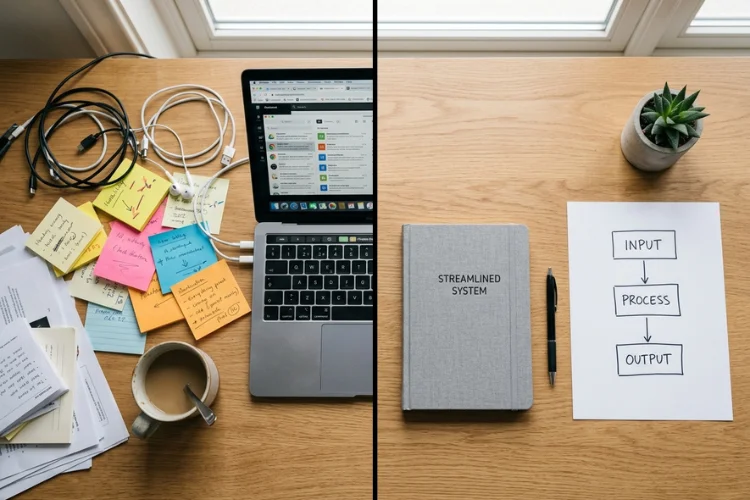
Here is where to look first:
Offers you are not fully behind. When I was running multiple offers at once, none of them got my full attention and none of them converted the way they should. The moment I cut to one, my messaging got sharper and my results followed.
Social platforms that are not paying off. Posting everywhere sounds like smart marketing. In practice it usually means five mediocre presences instead of one strong one. Pick your platform and go deep.
Tools you are paying for just in case. I have been through ClickFunnels, GoHighLevel, and Kajabi among others. Every tool sitting unused is not just a financial drain. It is mental overhead. Audit your subscriptions and cut what you are not actively using.
Standing calls that exist out of habit. Look at your recurring calendar blocks honestly. How many of those meetings could have been a message? Some are probably still on your calendar just because canceling felt awkward.
Content you are creating out of obligation. I was trying to maintain a blog, a podcast, and daily LinkedIn posts all at once with no structure behind any of it. The content suffered and so did I. Pick one format that plays to your strengths. Build from there.
The Mental Load Is the Real Problem
Here is something that gets missed in most conversations about business complexity: the problem is rarely the schedule. It is the mental load.
You can technically have a free afternoon and still feel like you are working. Because your brain never clocks out. It is still running tabs on everything. Did that email go out? Is the campaign still live? What is on the list for tomorrow?
Think of it like a browser with thirty tabs open. The tabs are not even the problem. It is what it costs the whole machine just to keep them all running.
That was my life. Even when I walked away from my desk, I never actually left.

When I simplified down to one offer, one traffic source, and a minimal tool stack, the mental load started to lift. Not overnight. But noticeably. And when the mental load drops, you become more present. A clearer thinker in the business. A better dad. A better husband.
Now I can walk away from my desk and actually be done. No open loops. No list running in the background at dinner. When my kids are talking to me, I am actually there. And honestly, sometimes the simplicity feels almost too easy. But it works so much better than everything I was doing before.
A Quick Gut Check for Your Business
Answer these honestly:
- Can you explain your business in one sentence?
- Do you have one offer you are fully confident in?
- Do you know exactly where your next customer is coming from?
- Is your weekly schedule protecting time for your family?
- Could your business function if you took three full days off?
If you said no to two or more of those, your business is more complicated than it needs to be. That is not a judgment. It is just a starting point.
Where to Start When Everything Feels Equally Important
The hardest part of simplifying is not deciding to do it. It is knowing where to begin when your whole list feels urgent.
Start with your offer.
Everything else in your business flows from your offer. Your content. Your marketing. Your tools. Your schedule. When your offer is clear, your messaging gets easier. When your messaging is easier, your marketing gets simpler. When your marketing is simpler, your week gets saner.
If you have to explain your offer at length before someone understands why they need it, it is too complicated. Clarity is not dumbing it down. Clarity is what sells.
This Is Exactly Why I Built the Revenue System Simplifier
After going through all of this myself, the complexity, the burnout, the late nights, and the dinner table moments where I was physically present but mentally somewhere else entirely, I built something specifically for online business owners in that same situation.
The Revenue System Simplifier is a $47 one time offer that walks you through identifying and vetting every offer, tool, and step in your current revenue system. It includes scoring tools and SOPs that help you see exactly where you are overcomplicating things and what to cut. You are always the one making the final call.
Most people who go through it simplify their business in 5 days.
It took me a couple of weeks of sun up to sundown focused work to build it out. I wanted it to be thorough. I also keep improving it over time, which is why the $47 gets you lifetime access as it grows.
No bloated strategies. No fluff. Just a clear process to strip your business back to what actually works and keep it that way.
If your business is making money but it does not feel like it is working for your life, this was built for you.
You Do Not Need More. You Need Simpler.
The version of success you actually want, the one where you are present with your kids and not working weekends out of anxiety, does not come from adding more.
It comes from getting clear on the right things and protecting them.
I have the multiple platform story. I have the $5,000 per month client I lost because I had no system. I have the 90 nights of staying up late and still feeling behind. And I have a son who had three open heart surgeries before his third birthday.
That will change how you think about time faster than any business book ever will.
You built something real. Now build it in a way that actually works for your life.
TLDR: Key Takeaways
- Complexity creeps in quietly. More offers, more tools, and more platforms feel like progress but usually just add mental load and dilute your focus.
- The real cost is your presence. A business running your evenings and your dinner table is not a business working for you.
- Simplifying means cutting, not adding. Start with your offer, then your platforms and tool stack.
- A simplified business has five things: one offer, one traffic source, one conversion system, a minimal tool stack, and a protected schedule.
- The mental load drops when you simplify. That is when you actually get to show up for the people who matter most.
- The Revenue System Simplifier ($47 one time, lifetime access) is a five day process to vet and simplify your entire revenue system.